
Wildlife
Alaska Whale Watching Guide
Humpback whales are the animal most people come to Alaska hoping to see, and the odds of seeing one on a boat trip in July are genuinely excellent. Understanding why they are here, where the food is, and how the season changes their behaviour turns a good sighting into a memorable one.
The short answer
Humpback whales feed in Southeast Alaska from roughly May to September, with July and early August the peak. The best whale watching ports are Icy Strait Point and Juneau, where operators commonly report sighting rates above 95 percent. Expect to pay 120 to 210 dollars per person for a three to four hour trip.
Key points
- Humpbacks feed in Southeast Alaska from May to September, peaking in July and August.
- Icy Strait Point and Juneau offer the best sighting odds in Alaska.
- Bubble net feeding is most often observed in Icy Strait.
- Smaller boats cost more and are worth it.
- No operator can guarantee an animal. A guarantee is a refund policy.
The humpback whales that feed in Southeast Alaska in summer spend their winters in Hawaii or Mexico, breeding and calving in warm water where there is almost nothing to eat. They arrive here in spring having lost a substantial share of their body mass, and they spend the summer doing one thing: eating.
That is why the odds are so good, and it is also why the odds change through the season.
Where the whales are
| Location | Odds on a boat trip | Why |
|---|---|---|
| Icy Strait Point | Very high | Nutrient rich water from Glacier Bay meets strong tidal currents |
| Juneau, Auke Bay | Very high | Stephens Passage is a major feeding area |
| Sitka | High | Outer coast, with a different species mix |
| Glacier Bay | High from the ship | Protected water with restricted vessel numbers |
| Ketchikan | Low to moderate | Whales pass through rather than concentrating |
| Skagway | Low | Deep fjord away from the main feeding grounds |
If your itinerary includes both Juneau and Icy Strait Point, book the whale trip at Icy Strait Point. The boats leave from the site itself rather than requiring a twelve mile road transfer, which means more time on the water for the same port hours.
When to go
Humpback distribution tracks their food, which in Southeast Alaska means herring and juvenile salmon.
- May: whales arriving from the south, thin and dispersed. Sightings good but less predictable.
- June: settling into feeding grounds. Very good.
- July: peak concentration. The best month.
- August: still excellent, with salmon adding to the food supply.
- September: beginning to disperse as they prepare to head south. Still good, with more travel between sightings.
Bubble net feeding
This is the behaviour worth understanding before you go, because if you see it you will want to know what you are looking at.
A group of humpbacks, sometimes four or five and occasionally more, works cooperatively. One whale swims in an upward spiral beneath a school of herring, releasing a curtain of bubbles that the fish will not swim through. Another vocalises, driving the school upward. The trapped herring are concentrated into a tight ball near the surface, and the whole group then lunges up through the middle with mouths open.
What you see from a boat is a ring of bubbles appearing on the surface, a few seconds of nothing, and then several enormous mouths breaking the water together. It is over in perhaps four seconds.
It is learned behaviour rather than instinct, practised by particular groups, and Southeast Alaska is one of the best places in the world to see it. Icy Strait is where it is observed most often.
What else you will see
A whale watching trip in Alaska is rarely only about whales.
- Steller sea lions hauled out on rocks and channel markers, loud and unmistakable
- Harbour seals, often on floating ice near glaciers
- Bald eagles, near certain in any coastal setting
- Dall's porpoise, fast and strikingly black and white, sometimes bow riding
- Sea otters, particularly around Sitka
- Orca, less reliable than humpbacks but present
Choosing an operator
The single most useful question to ask is boat capacity. A twelve passenger vessel and a hundred and forty passenger catamaran are entirely different experiences at broadly similar prices.
| Boat size | Typical price | What you get |
|---|---|---|
| 6 to 16 passengers | $180 to $260 | Close viewing, flexible routing, a naturalist you can talk to |
| 20 to 50 passengers | $150 to $210 | A good balance, usually with indoor seating |
| 100 plus passengers | $120 to $180 | Cheapest, stable, but you queue for the rail |
Other questions worth asking:
- Does the price include the transfer from the berth, particularly in Juneau
- Is there indoor heated seating, which matters more than people expect
- What is the sighting policy, and what does a guarantee actually pay
- How long is the trip on the water rather than the total duration
On guarantees
Many Alaska operators advertise a whale sighting guarantee. It is worth understanding what that means: it is a refund policy, not a biological promise. Typically it entitles you to a partial refund or a free repeat trip if no whale is seen. Given that the underlying sighting rate in July is above 95 percent, the guarantee is a marketing device that costs the operator very little.
That is not a criticism. It just means the guarantee should not be a deciding factor between operators.
Photographing whales
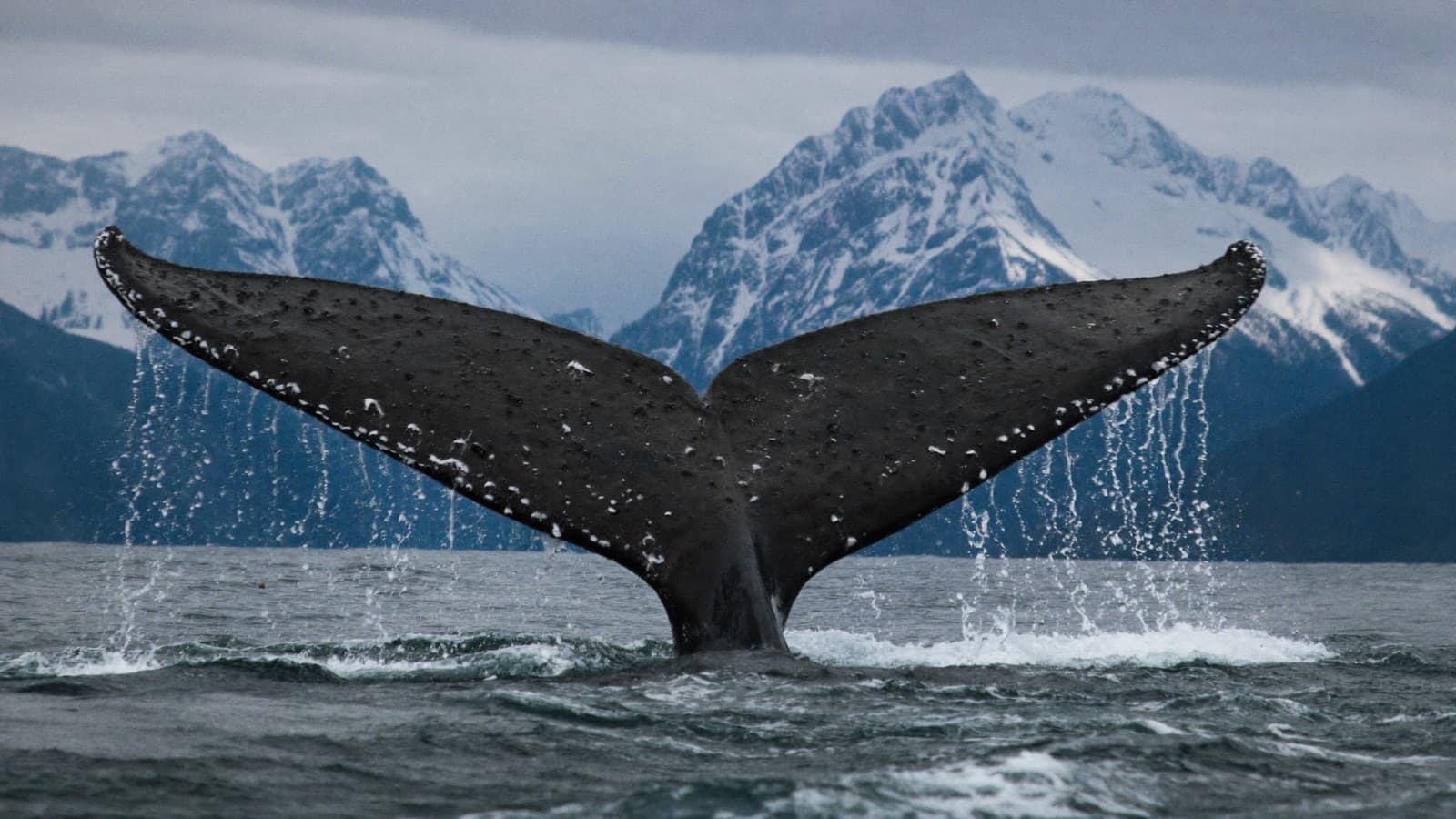
The classic shot is the fluke as the whale sounds, and you have about two seconds to take it.
- Watch for the arched back. That is your cue.
- Use continuous autofocus and burst mode.
- Set 1/1600 second or faster. The boat moves and the whale moves.
- Skip the polariser. It costs you a stop and a half of light exactly when you need speed.
- 200mm is workable, 400mm is better. Most action happens at 100 to 300 metres.
More detail in our Alaska cruise photography guide.
What to bring
A waterproof shell, a hat, gloves and something warm underneath. Boats feel considerably colder than land at the same temperature because you are stationary and exposed. Binoculars are genuinely useful for scanning between sightings. A dry bag for the camera is worth the small cost.
For the full excursion picture including costs by port, see Alaska shore excursion costs.
Frequently asked questions
Where is the best whale watching on an Alaska cruise?
What months are best for whale watching in Alaska?
What is bubble net feeding?
Can I see whales from the cruise ship itself?
Related articles
Wildlife
Bear Viewing on an Alaska Cruise
How to see bears on an Alaska cruise, which ports offer viewing, why timing matters more than money, and what the realistic odds are.
Updated
Wildlife
Wildlife You Can See on an Alaska Cruise
A realistic guide to Alaska cruise wildlife, with sighting likelihood for each species, where and when to look, and how to improve your odds.
Updated
Destinations
The Best Alaska Cruise Excursions
The best shore excursions on an Alaska cruise, ranked, with prices, durations and honest assessments of which ones are worth the money.
Updated