
Fjord
Endicott Arm and Dawes Glacier
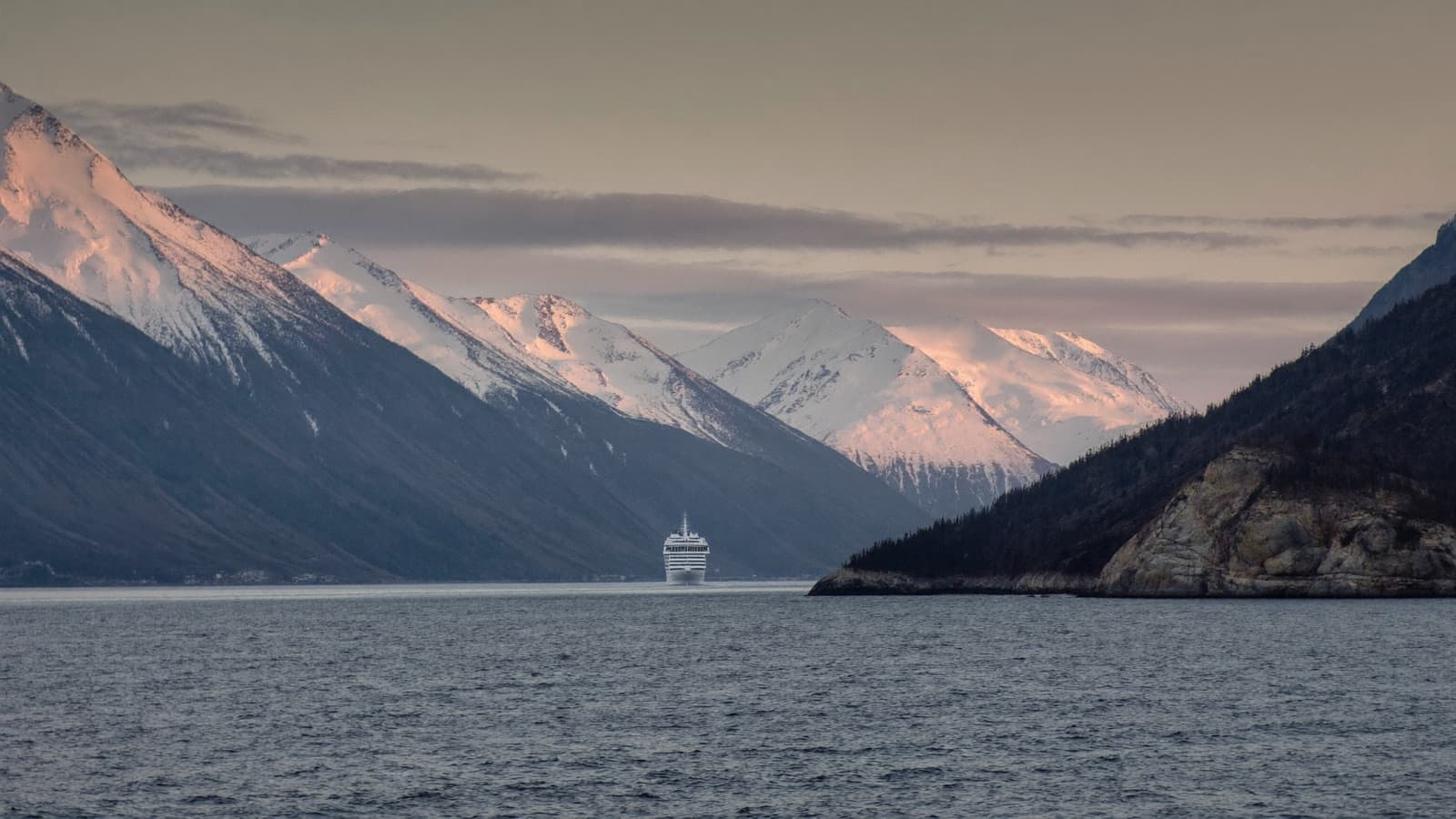
Endicott Arm is the southern of the two fjords branching from Holkham Bay, ending at Dawes Glacier. It is somewhat wider and more consistently navigable than neighbouring Tracy Arm, which is why many large ships end up here even when the itinerary mentions Tracy Arm first. Dawes is an actively calving tidewater glacier and the fjord routinely carries heavy floating ice.
The short answer
Endicott Arm is a 30 mile fjord south of Juneau ending at Dawes Glacier, a tidewater glacier roughly half a mile wide and 200 to 250 feet high. Ships often visit it in place of Tracy Arm because it is wider and more navigable. Expect three to five hours of scenic cruising with heavy floating ice and large numbers of harbour seals.
Key points
- Ends at Dawes Glacier, an actively calving tidewater glacier around half a mile wide.
- Wider and more consistently navigable than neighbouring Tracy Arm, so ships often choose it.
- The fjord routinely carries heavy floating ice, which limits how close ships can get.
- One of the best places on the circuit for harbour seals hauled out on ice.
- Often listed on itineraries as "Tracy Arm or Endicott Arm". The captain decides on the day.
Quick facts
- Region
- Alaska, United States
- Typical time here
- 3 to 5 hours of scenic cruising
- Best months
- June, July, August
- Wildlife
- Harbor sealMountain goatBald eagleBlack bearHumpback whaleArctic tern
What Endicott Arm is like
Endicott Arm and Tracy Arm share an entrance at Holkham Bay, about 45 miles south of Juneau. Endicott runs southeast for roughly 30 miles, ending at Dawes Glacier. It is a classic glacial fjord: steep granite walls, hanging valleys, waterfalls, and water deep enough that the ship can approach the walls closely.
Compared with Tracy Arm it is marginally wider and its approach is less constrained, which is the practical reason so many large ships end up here. Passengers who expected Tracy Arm sometimes feel they got the second choice. In reality Dawes Glacier is more consistently reachable than the Sawyer glaciers, so a ship in Endicott Arm frequently gets closer to actual ice than a ship in Tracy Arm does.
Dawes Glacier itself is roughly half a mile wide at the face, standing 200 to 250 feet above the water. It calves frequently, and the resulting ice can fill the upper fjord densely enough that the ship holds a mile or more out.
What the day involves
- Entry at Holkham Bay in the early morning on most itineraries, often around 5:00 to 7:00 am.
- Transit up the fjord taking around ninety minutes to two hours, with waterfalls and hanging valleys on both sides.
- Holding position near Dawes Glacier for roughly 45 to 90 minutes, with a rotation so all sides get a view.
- Ice navigation, which is often the most interesting part. Watching a large ship work carefully through brash ice is genuinely absorbing.
- Exit and continue, usually toward Juneau or south toward Ketchikan.
Wildlife in Endicott Arm
Endicott Arm is one of the best places on the whole circuit for harbour seals, because the dense floating ice near Dawes Glacier is exactly the habitat they use for pupping and resting.
| Species | Where | Likelihood | Notes |
|---|---|---|---|
| Harbor seal | On floating ice near Dawes Glacier | Very high | Often dozens or hundreds visible at once |
| Mountain goat | Cliffs along the fjord | Moderate | Scan high ledges with binoculars |
| Bald eagle | Throughout the fjord | High | |
| Arctic tern | Near the glacier | Moderate to high | Nesting on gravel bars in summer |
| Black bear | Shorelines | Low to moderate | |
| Humpback whale | Holkham Bay entrance | Moderate |
Best time to visit Endicott Arm
| Month | Conditions | Notes |
|---|---|---|
| May | Heavy ice, cool | Approach may be limited. Seal pupping under way |
| June | Moderate ice, long days | Excellent light, seals abundant |
| July | Best navigability | Best odds of a close approach to Dawes |
| August | Good, wetter | Reliable, with more low cloud |
| September | Variable | Clearer air when settled, less predictable weather |
Photography tips for Endicott Arm
- Dawn light is the whole opportunity. Most Endicott transits happen very early. That is when the water is calm, the light is low and warm, and there is nobody else on deck.
- Photograph the seals on the ice. A 300 to 400mm lens and a raft of seals on a blue white floe is one of the most distinctive Alaska images available from a ship.
- Use the ice for foreground. Rather than shooting the glacier face flat on, compose with brash ice in the near field. It gives depth that a clean shot of the face lacks.
- Expect low light and grey conditions. Fjord walls block direct sun for much of the transit. Be prepared to push ISO to 800 or 1600 rather than accepting a slow shutter.
- Waterfalls suit a slower shutter, but not from a moving ship. If you want silk water you need the ship stationary. Otherwise freeze it at 1/500.
- Look behind you. The best composition in a fjord is often astern, looking back down the corridor you have just come up, particularly when the sun is behind you.
Excursions and prices
| Excursion | Duration | Typical price | Effort | Notes |
|---|---|---|---|---|
| Dawn deck viewing during the transit | 3 to 5 hours | Included | Easy | The best light of the entire cruise, and almost nobody is up for it. |
| Forward observation lounge | 3 to 5 hours | Included | Easy | Warm option with good sightlines, especially on Norwegian Breakaway Plus ships. |
| Naturalist commentary | During the approach | Included | Easy | Varies by line. Ask at guest services when it is scheduled. |
Frequently asked questions
What is the difference between Endicott Arm and Tracy Arm?
How close do ships get to Dawes Glacier?
Is Endicott Arm worth getting up early for?
What wildlife is in Endicott Arm?
Why does my itinerary say Tracy Arm or Endicott Arm?
Is Dawes Glacier as impressive as Margerie or Hubbard?
Cruise lines and planning guides for this stop
A detailed guide to Royal Caribbean in Alaska: which ships sail, why it does not visit Glacier Bay, family suitability, dining, cabins, pricing and how it compares.
A detailed guide to Norwegian Cruise Line in Alaska: ships, Glacier Bay access, Freestyle cruising, the Haven suite complex, cabins, dining, pricing and who it suits.
A detailed guide to Disney Cruise Line in Alaska: which ships sail, family programming, rotational dining, cabins, glacier viewing, pricing and whether it is worth the premium.
A detailed guide to Celebrity Cruises in Alaska: Edge and Solstice class ships, glacier itineraries, adults leaning atmosphere, dining, cabins, pricing and who it suits.
A tested Alaska cruise packing list built around layering: what to bring, what quantities, what to leave at home, and what changes by month and cabin type.
How to structure an Alaska cruise port day: real available time, gangway queues, tendering, all aboard timing, what to carry and how to build in a buffer.
Whether a balcony is worth the money on an Alaska cruise: how much you actually use it, what the ship rotation means for views, and when an interior is the smarter choice.
How to choose Alaska shore excursions: what is worth booking, ship versus independent operators, real prices by port, weather cancellations and how many to book.